Dubeys of great Indian politics..
A man enters in police station with pistol in his hand and guns down minister of state in rajnath singh's state government santosh shukla in front of station in charge and still not a single present police personnel gives statement .now you could imagine the fear of Vikas Dubey in minds of people that even people who are entrusted for maintaining law and order of state kept mum.
---fast forward to ----
july, 2020( kanpur, uttar-pradesh)-
8 police personnel including 1 DSP gets killed when they went to arrest notorious history sheeter Vikas Dubey to his mansion like house with fort-like gate. and the bahubali is now on run and whole of state police force is in search of him.
doesn't it feel cinematic , the way things are unfolding about this person called vikas dubey. has anyone remember the scene in first part of gangs of wasseypur where sardar khan slaps mla j.p singh and authority remained passive observer. after that incident sardar khan became sardar khan.
the plots of this movie fits so well with the story of vikas dubey and incompetency of state authority to deal with such dubey's. what has really happened in between 2001 and 2020 ? why it took 20 years for authority to curtail this man's power? from where did vikas dubey acquired automated weapons?
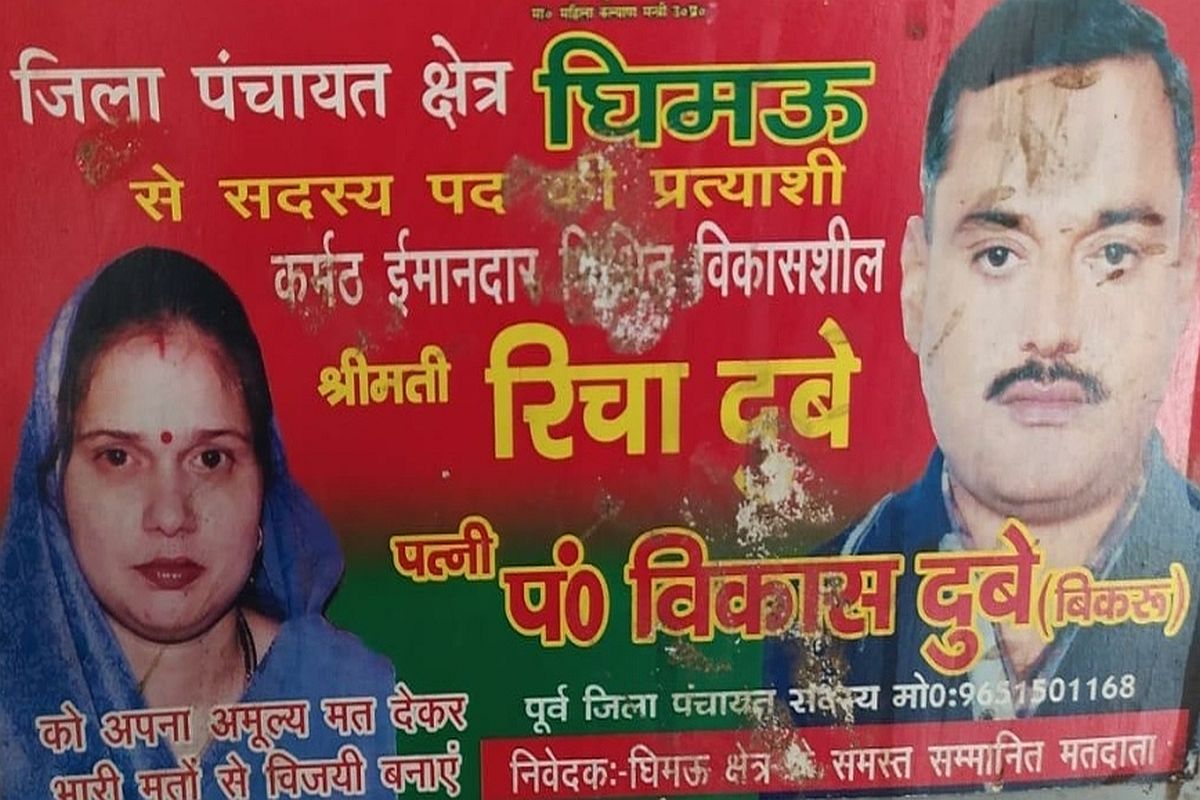
part of answer lies in every aspect of society , may it be social, political or economical. vikas dubey entered into politics and became member of zilla parishad on ticket of Bahujan samaj party. he was benefited immensely due to his caste(brahman). now his wife has taken over his seat. not a single grampanchayat election has been held in his village , person towards whom dubey points fingers becomes power holders . this is how the whole grassroot democracy is being managed in whole Purvanchal (northeast part of UP) so this whole fiasco is not an overnight phenomenon it is mix of caste+muscle+money i.e social+political+economic. as i have written in disclaimer we remember the faces but forget the stories so to understand the rise of such many more dubey's in indian politics will need to ask a simple question , why are these people necessary for political community?
consider a stable and balanced atom where net neutral charge is zero , being neutrally zero does not necessarily mean that there is no energy ,of course there is energy but it is balanced by equal amounts of protons and electrons. what if i take out single electron? at that very point it would loose its stability and becomes radioactive
now imagine a political system where it is stabilised by various actors like government, bureaucracy, organisations,political parties by balancing power(energy) of each other. what if suddenly one of the actors gets out of picture ? then? balance of power get disturbed and it creates void/vacuum in political space and whenever there is vacuum ,either due to absence of state or inability of state to govern, then that vacuum gets filled by local power holders,bahubali's, and once they enter into this political space it is nearly impossible to remove them from political equation .
creation of such vaccum of power is not an overnight phenomenon, it has history of over 70 years , history of independent india , which is argued below
1940s to 1960's- era of administrative vacuum
Rajni kothari , prominent political commentator very eloquently described india's political system after 1947 as Congress system. congress and its leadership rode on immense popularity because of their contribution in freedom struggle and they remained only national option (though there were 50+ parties in first general election ) for decades to come.

the most important contribution of grand old party is they never allowed any political vacuum to emerge after british left the continent. one of reason for absence of that vacuum is congress's reach in every prominent region and its gradual emergence from its birth (1985). Whether critics of congress would like it or not but congress is reason of emergence of modern Indian nationalism devoid of any communal aspect and this sense of plural Indianess made it possible for congress to create union of India from such diverse ethnic regions.
In the euphoria of political independence, what we failed to address as a nation and particularly as a civil society is dark history and reality of caste discrimination . even though Gandhi in early 1930s tried to address those issues but ambiguities within his views about caste and varna and eagerness of new leadership to acquire political freedom left the fundamental voids unaddressed .Dr. Ambedkar fought for rights of all downtrodden but his voice never went beyond lower caste even though he is the reason that hindu women enjoy economic rights and still hindu uppercast never acknowledge his contribution. Constitutional assembly tried to give rights to untouchables by constitutional provision.but Law can not and should not be answer of every social issue , what it does at best is to create deterrence and deterrence only works where there is administration to enforce the law.
Has someone remember the movie named “manjhi”, story of man who single handedlly created a road by breaking a hill. In the very beginning when dasharath manjhi comes back to his village he saw a procession , people were dancing and chanting “sab barabar” and he asked someone in his mother tongue “ka hua re”(what is happening?) and man says “ chuachut ka kahani khatam ,sarkar ne kanoon banaya hain ,sab barabar”(story of untouchability has now ended, government has made law, everyone is now equal) manjhi joins them in celebration. At some distance some upper caste people standing on stairs of temple with sticks(lathi) in their hands . while looking towards that procession with anger. One of them says “sapna dekh rahe hain saale, mandir mein ghusenge” and other responds by “ dus-bees ka bali nahi chadhegha tab tak sudharega nahi saala sab” . what we should understand from plot of this movie is untouchables thought of law as panacea for all their suffering but uppercast saw it otherwise and The issue of caste was buried under the “awaken India” and popular conscious moved forward to fulfil their “tryst with destiny” leaving monster to remerge in late 1980s
The biggest contribution of british in making of modern India is their system of administration. They unified the country in single centralised administration (whether it was to loot India or to buid India is debate for another day.)
Subsequently when british withdrew from subcontinents affairs and they left massive void in administration of newly independent nation to not be get filled for many more decades to come. language, geography, culture, values in India changes at every 100 km and to create a centralised bureaucracy in such far stretch country itself was a humongous task but contrary to that first prime minister of country wanted to abolish the whole system altogether but it was farsightedness of sardar patel that he stopped Nehru from doing so and ‘Still Frame’ was saved.
It was quite ironic that self declared socialist like Nehru wanted state-led development but without machinery to enforce and implement it and without one of largest lubricant called civil services. Milan vaishnav, political scientist in preface to his book “when crime pays” very subtly states the irony of those times
“the problem with Indian state is not that it is too big;
it is that it is big in all wrong places”
This being big in wrong places left voids in necessary places and state of anarchy in other places, which neither helped economic development nor reduced the social discrimination.
Just to let grasp the scenario of those times i would like put an anecdote from autobiography of IPS Julio ribeiro named “Bullet For Bullet” , His second posting as DSP was in nashik and he was provided cycle for office use due to lack of vehicle and resources in states account.
To again bring the parallel from same movie “manjhi”, mukhia(head) of village with irritations says to his men, “arey yaar sarkar ne jaat paat khatam kar diya, kuch dinon baad kahenge zamindari khatam kar do. Aag lag jayegi bhai desh mein ! matha fir gaya hain kya sabka?”( government has abolished caste, tomorrow they will ask to abolish landlord. Country will catch fire! Are everyone out of their mind?) and his man response by saying “ chodiye na mukhia ji, kanooon bakhare se ka hota hain, lagoo kaun karega?”( leave it sir, nothing would happen just by making law, who will implement it?)
This whole argument of “who will implement it?” actually sums up the era of 1940s and 1950s, This kind of inability of state led to creation of local leaders who not only kept their area of influence intact but even opposed the social change .
1970s to 1980s
ERA OF POLITICAL VACUUMs
, EMERGENCY, DISAPPOINTMENTS,
The euphoria of free india was dying, people are not ony disappointed but even convince in fact that nothing is going to change , with debacle in 1962 and within next four years death of two prime minister one of them being Jawaharlal Nehru and other being soft spoken lal bahadur shashtri created political vacuum of such massive extent first time in independent india . what subsequently followed was unprecedented chaos, some of issues are noted here,
1) Balance of payment issue and followed by devaluation of rupee in hope to increase export
2) High budget deficit due to large portion of budget devoted to defence modernization
3) Continous drught for 2 years 1965-1966 followed by food scarcity , bihar and u.p were worst hit states
4) Social unrest from every part of society, teachers, youth, labour, farmers, landlords and even sadhus and sants
5) Breakdown of congress’s organizational structure and factionalism in congress
6) Parliament as institution began to loose its credibility
7) Birth of regional aspiration, mahrashtra, Punjab, naga, mizo etc
8) First time congress lost in state like bihar and u.p but newly created coalition government failed to provide stability.
9) Defection in parties lead to further chaos , from 1967 to 1970 bihar saw seven governments and uttar Pradesh witnessed 4 goverment.
This being big in wrong places left voids in necessary places and state of anarchy in other places, which neither helped economic development nor reduced the social discrimination.
Just to let grasp the scenario of those times i would like put an anecdote from autobiography of IPS Julio ribeiro named “Bullet For Bullet” , His second posting as DSP was in nashik and he was provided cycle for office use due to lack of vehicle and resources in states account.
To again bring the parallel from same movie “manjhi”, mukhia(head) of village with irritations says to his men, “arey yaar sarkar ne jaat paat khatam kar diya, kuch dinon baad kahenge zamindari khatam kar do. Aag lag jayegi bhai desh mein ! matha fir gaya hain kya sabka?”( government has abolished caste, tomorrow they will ask to abolish landlord. Country will catch fire! Are everyone out of their mind?) and his man response by saying “ chodiye na mukhia ji, kanooon bakhare se ka hota hain, lagoo kaun karega?”( leave it sir, nothing would happen just by making law, who will implement it?)
This whole argument of “who will implement it?” actually sums up the era of 1940s and 1950s, This kind of inability of state led to creation of local leaders who not only kept their area of influence intact but even opposed the social change .
1970s to 1980s
ERA OF POLITICAL VACUUMs
, EMERGENCY, DISAPPOINTMENTS,
The euphoria of free india was dying, people are not ony disappointed but even convince in fact that nothing is going to change , with debacle in 1962 and within next four years death of two prime minister one of them being Jawaharlal Nehru and other being soft spoken lal bahadur shashtri created political vacuum of such massive extent first time in independent india . what subsequently followed was unprecedented chaos, some of issues are noted here,
1) Balance of payment issue and followed by devaluation of rupee in hope to increase export
2) High budget deficit due to large portion of budget devoted to defence modernization
3) Continous drught for 2 years 1965-1966 followed by food scarcity , bihar and u.p were worst hit states
4) Social unrest from every part of society, teachers, youth, labour, farmers, landlords and even sadhus and sants
5) Breakdown of congress’s organizational structure and factionalism in congress
6) Parliament as institution began to loose its credibility
7) Birth of regional aspiration, mahrashtra, Punjab, naga, mizo etc
8) First time congress lost in state like bihar and u.p but newly created coalition government failed to provide stability.
9) Defection in parties lead to further chaos , from 1967 to 1970 bihar saw seven governments and uttar Pradesh witnessed 4 goverment.
 between same period 800 assembly members in all over india defected to another parties and surprisingly 155 of them were
rewared with ministerial offices
between same period 800 assembly members in all over india defected to another parties and surprisingly 155 of them were
rewared with ministerial offices10) within period of
10 years india fought 3 wars, and faced with refugee crisis in 1971
11) split in old grand party.1969
12) red tapism and bureaucratic procedures made it difficult for private businesses to sustain.
The beginning of quid pro quo( give and take)
In all of these scenario, the biggest blow to political parties came in form of amendment to companies act in 1969, which imposed a total ban on corporate givings to political parties. Milan vaishnav notes that
“the ban combined with new restrictions on business led to the proliferation of black money in the political system.”
Now this blunder by indira Gandhi paved way for those who are in black economy and were in want of political patronage, running a political party is costly affair.it do not only demand workers but finances are most important thing and now that law prohibits businessmen from funding then it was inevitable for political parties to come to terms with these gundas and dons.
It was not just political economy that transformed the crime and politics nexus but even political interests also played big role. As we have seen the emergence of regional parties was blow to congress’s grass root organization. under Sanjay Gandhi, congress(i) devised plan to counter the opposition by fuelling the thugs and fanatics in each state rather than buiding ones own base.
Examples in these cases are
1) Gernail singh bhindranwale-
To counter akali dal’s politics in state of Punjab, congress build bhindranwale, religious scholar, highly conservative, loved by sikh youth . congress initially believed that they can control bhindranwale but they underestimated the popularity he gained .
11) split in old grand party.1969
12) red tapism and bureaucratic procedures made it difficult for private businesses to sustain.
The beginning of quid pro quo( give and take)
In all of these scenario, the biggest blow to political parties came in form of amendment to companies act in 1969, which imposed a total ban on corporate givings to political parties. Milan vaishnav notes that
“the ban combined with new restrictions on business led to the proliferation of black money in the political system.”
Now this blunder by indira Gandhi paved way for those who are in black economy and were in want of political patronage, running a political party is costly affair.it do not only demand workers but finances are most important thing and now that law prohibits businessmen from funding then it was inevitable for political parties to come to terms with these gundas and dons.
It was not just political economy that transformed the crime and politics nexus but even political interests also played big role. As we have seen the emergence of regional parties was blow to congress’s grass root organization. under Sanjay Gandhi, congress(i) devised plan to counter the opposition by fuelling the thugs and fanatics in each state rather than buiding ones own base.
Examples in these cases are
1) Gernail singh bhindranwale-
To counter akali dal’s politics in state of Punjab, congress build bhindranwale, religious scholar, highly conservative, loved by sikh youth . congress initially believed that they can control bhindranwale but they underestimated the popularity he gained .
 |
| bhindranwale with his arme followers in delhi. |
2) Shivsena-
It is in late 1960s, congress under cheif minister Vasantrao naik was facing grave situation. 2 years of continues drought created an anti-congress sentiment . Bombay mills worker were united under communist trade union which was being lead by young George fernandise, he had ability to halt country’s economic capital single handedly .
s.k patil with mumbai’s business lobby were in search of someone who would not only counter but destroy the whole communist party from Bombay, they found that option in bal thakrey, they supplied thakrey with money and state power to counter the communist trade union. Kamgar sena was the new organizations. fierce views, great oratory skills , government support , popularity among unemployed youth made it possible for shivsena to acquire stronghold in Mumbai.
 |
| manya surve with bal thakrey |
The politics of 1960s and 1970s was in way created space for pressure groups , the voids were being filled everywhere and now it was time of that monster to come out which was buried under hopes and aspirations of free india and that is “caste”.......
1980S – CONTINUE- era of social vacuum
MANDAL, MANDIR, MAFIA
Initial disenchantment about “mai-baap sarkar” was experienced in every social group, “garibi hatao” did not proved to be effective. State party was becoming strong force and electoral merit rather than history of candidate was now new normal. One more interesting factor emerged in politics was ‘dynastical politics’. At every level of party either someone’s son or daughter .
Post emergency , new young leadership in every was attracting voter base, lalu Prasad yadav, nitish kumar are prominent ones. Congress was uprooted from bihar, uttar Pradesh. Not just these leaders but those pressure groups like shivsena entered into electoral politics .in south reddy’s became force to reckon with. DMK’s split in early 1980s was major factor national politics.
Rajiv Gandhi blunder –
In year 1985, muslim personal law was challenged by supreme court in famous shah bano case, but to appease and pamper muslim community rajiv Gandhi brought legislation to nullify supreme courts rulling.
Hindu nationalism which was gaining ground since 1930s has got chance to expose hypocrisy/pseudo secular nature of congress under curtain of secularism and began to portray congress as antihindu party , so now to gain the lost hindu base rajiv Gandhi did something which still haunts the integrity and plural fabric of india. 1 february 1986 faizabad district court ordered to open gates of babri masjid it opened pandora’s box .
Now this changed whole poitical scenario, everyone was trying to win over hindu base, muslims were relegated to background and whole focus of all political parties was to intact its hindu base , V p singh broke the vertical hindu organization by promising to implement recommenadations of mandal commission , i.e 27 % reservation to other backward classes.
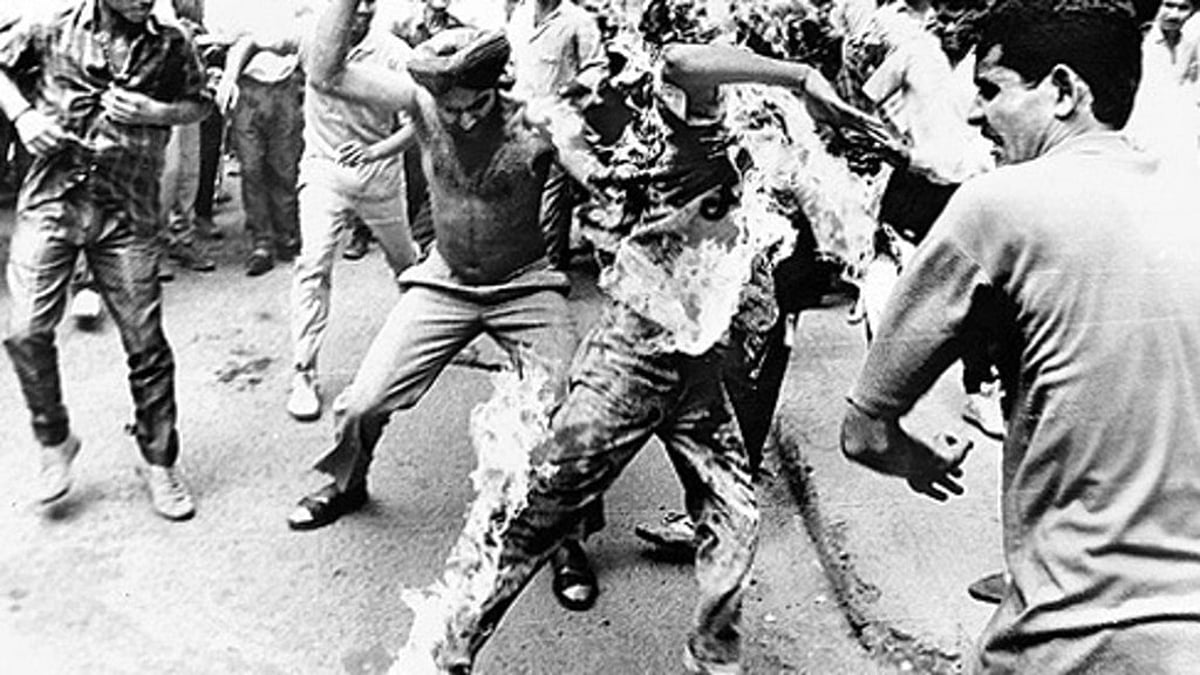 |
| rajiv goswami, BA final year student sets himself on fire. |
Now how to counter this mandal politics, pramod mahajan came up with plan of rathyatra( chariot procession) from somnath in gujrat to ayodhya in uttar Pradesh and what happened on 6 december 1992 was history. Clouds of communalism were all over the country. Demolition of babri masjid was one of those moment in history of independent india which changed the course of future.
Now heres the catch , earlier those pressure groups and bahubali’s were on periphery of electoral politics, they used to finance and provide manual power for political parties but now as caste and religion awareness brought them into elections. Their caste, money and muscle now was all combined to take over election and rather than being kingmaker they chose to be king themselves.
The coalition era post rajiv Gandhi created some political compulsions for all political parties across the spectrum. Pappu yadav, ateeq ahmed, mohammad shahabuddin, afzal ansari, arun gawli a.k.a daddy etc. Were now part of poitical system and vikas dubey is just another case of such nexux.
We are not to discuss the ethical implications of such nexus but more of a system. which whether you like it or not but is there and is working more efficiently than ever. Privatisation only helped this partnership to broaden its scope and include corporate into this nexus.
